general
Multilingual GEO: Build Useful English and Spanish Pages
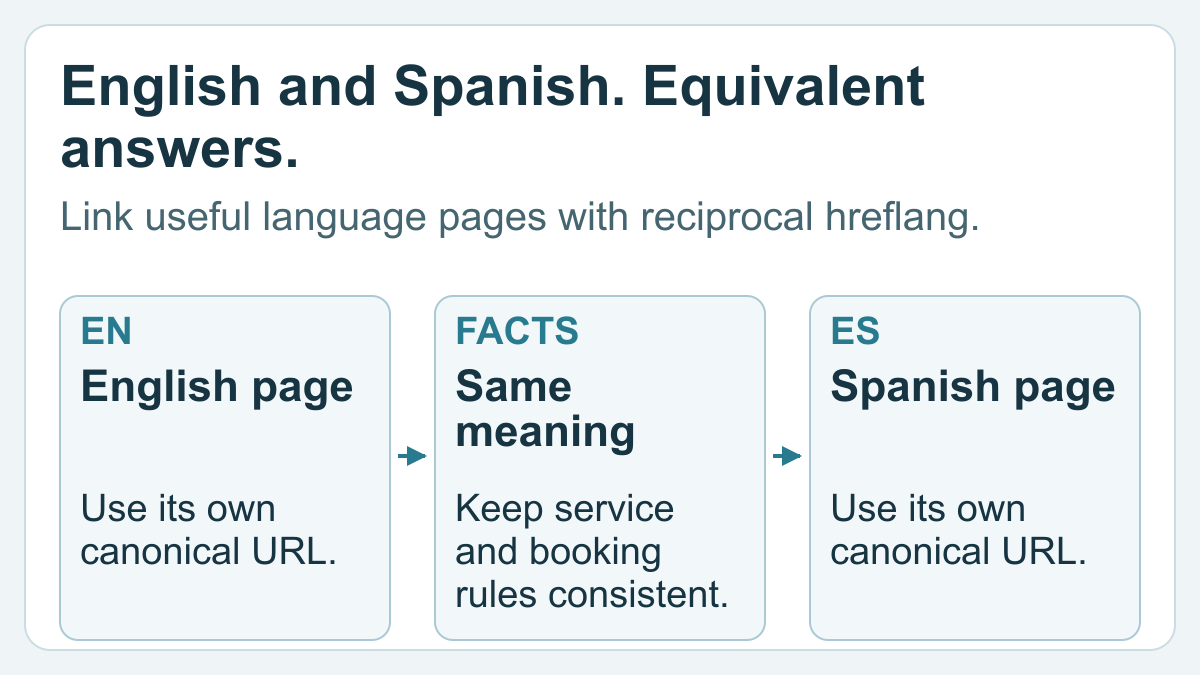
Consider an approved service page that says consultations require an appointment. Its Spanish version must preserve that condition, explain how to book, and link to a usable next step. Translating the navigation while leaving the explanation in English does not give a Spanish-speaking visitor the same useful page.
Start with real audience needs and approved facts
Choose which page deserves translation by reviewing actual customer questions, inquiries, and the information staff can support in that language. If those records are unavailable, treat suggested questions as editorial hypotheses, not proven demand.
Keep one fact record behind the language versions. It should cover the actual services, location or service area, operating limits, booking rules, prices where approved, and who can answer follow-up questions. Translation must not invent a Spanish-speaking employee, a new office, or a service the business cannot deliver.
Use a brief like this:
| Decision | What must be established |
|---|---|
| Audience | Which visitors need the page in this language? |
| Main question | What decision should the page help them make? |
| Facts | Which operating details are approved and current? |
| Review | Who can check both meaning and business accuracy? |
| Next step | Can the visitor complete the contact or booking path? |
The multi-location visibility guide is useful when language and location overlap. A language version and a new location page solve different problems.
Give each language a page the reader can find
For a simple two-language site, separate paths can make ownership clear: an English service page and its Spanish equivalent.
Google recommends different URLs for different language versions. It also explains that it identifies language from visible page content, rather than the URL or an HTML language label. Translate the main explanation and navigation coherently; changing only the header is insufficient.
Use a visible language switch linking to the equivalent page. Avoid forcing visitors to a different language based on a guess about their preference. Google's guidance warns that automatic language redirects can prevent people and search engines from viewing every version.
Review headings, forms, error messages, confirmation screens, and contact instructions. A polished Spanish article followed by an unusable English-only booking flow leaves the reader's task unfinished.
Connect equivalent pages with hreflang
Hreflang identifies language or regional alternatives of the same content for Google. Each included version should list itself and its alternatives, with fully qualified URLs and reciprocal links. Those requirements come from Google's localized-page documentation.
Here is an illustrative pair using reserved example URLs, not pages belonging to a real business. Place the same alternate links in the HTML head of both equivalent pages:
<link rel="alternate" hreflang="en"
      href="https://example.com/en/service-details" />
<link rel="alternate" hreflang="es"
      href="https://example.com/es/detalles-del-servicio" />
Use language codes matching the intended audience. Add a region only when the version genuinely targets that region; Spanish-language content is not automatically content for Spain. Do not annotate an unpublished, unrelated, or nonexistent page as an equivalent.
Canonical tags solve another problem. They indicate a preferred URL for duplicate or very similar pages. Google's canonical guidance recommends a canonical in the same language when using hreflang. For two genuine translations that are each the preferred page in their language, use the corresponding page as its own canonical instead of pointing both at English.
Keep canonical and language-alternative signals consistent. Hreflang cannot repair an English URL that redirects unexpectedly, a Spanish page excluded from indexing, or content missing from the page users actually receive.
Localize the explanation without inventing local evidence
A good translation preserves meaning and removes ambiguity. Adapt an example or phrase when it makes the explanation clearer, but retain the same verified service limits and conditions. A fluent reviewer should check terms that affect a customer's decision, not merely grammar.
If the business offers an assessment before a final quote, both versions should explain that distinction. Do not let “request an assessment” become “receive a fixed price” in translation. If a service is appointment-only, preserve that condition wherever the booking instruction appears.
Do not multiply pages by replacing a city name in the same text. Google's doorway-abuse policy identifies substantially similar pages created to capture related queries and funnel visitors onward as a problem. A genuine translation for a real audience is different from a collection of fabricated location pages.
Verify each page, then evaluate each language
Use the same release checklist for English and Spanish:
- The main question is answered clearly in the page's language.
- Business facts and limitations match the approved record.
- Source links support the adjacent claims.
- Language-switch links reach the equivalent page.
- Canonical and hreflang targets are valid and consistent.
- Visitors can complete the intended contact or booking step.
- The page's important content is accessible for search review.
Use the content visibility checklist if the page's displayed content depends on rendering. The AI search audit guide covers the broader foundation before expanding the language set.
For AI-answer observation, keep English and Spanish questions in separate groups. Record the exact wording, language, location assumptions, platform, date, cited URLs, and factual errors. An English citation does not establish that the Spanish page was found or used.
Google's AI-feature guidance still applies: ordinary Search foundations matter, and no special AI markup is required. Treat the multilingual release as verified content and navigation work; treat any later citation as a separately observed result.
FAQ
Is translating the homepage enough?
Only if the homepage fully answers the audience's relevant question and provides a usable next step. For a service decision, visitors may also need the service explanation, limitations, booking instructions, and contact path in their language. Translate the complete task, not just the entry point.
Do hreflang tags make ChatGPT cite the Spanish page?
No. Google's hreflang guidance concerns language alternatives in Google Search. It does not establish a ChatGPT citation guarantee or a universal AI ranking signal. Verify page accessibility and usefulness, then observe actual cited URLs for the Spanish questions you test.
Should every Spanish page point its canonical to English?
No. For genuine translations, review canonical preferences within each language. Google's documentation recommends a canonical in the same language when using hreflang. Do not make English the preferred URL by default merely because it was published first.
Can a machine translation be published without review?
A translation still needs checks for meaning, operating facts, terminology, and the visitor's next step. Errors in appointment rules or service exclusions can change the promise being made. Use a reviewer able to verify the language and the approved business conditions.
How should several cities and languages be organized?
Start from actual service coverage and distinct reader needs. Translate useful pages where there is a supported audience, and create location pages only when their facts and purpose justify them. Do not imply offices, staff, or services simply to fill a city-and-language grid.