general
Your First 30 Days of GEO: A Deliverables and Acceptance Plan
Imagine receiving a report that says “six articles published” but provides no original questions, source checks, or before-and-after evidence. You cannot tell whether the team solved the right problem. A better handover identifies the question each page answers, who approved its claims, where it was published, and what remains unobserved.
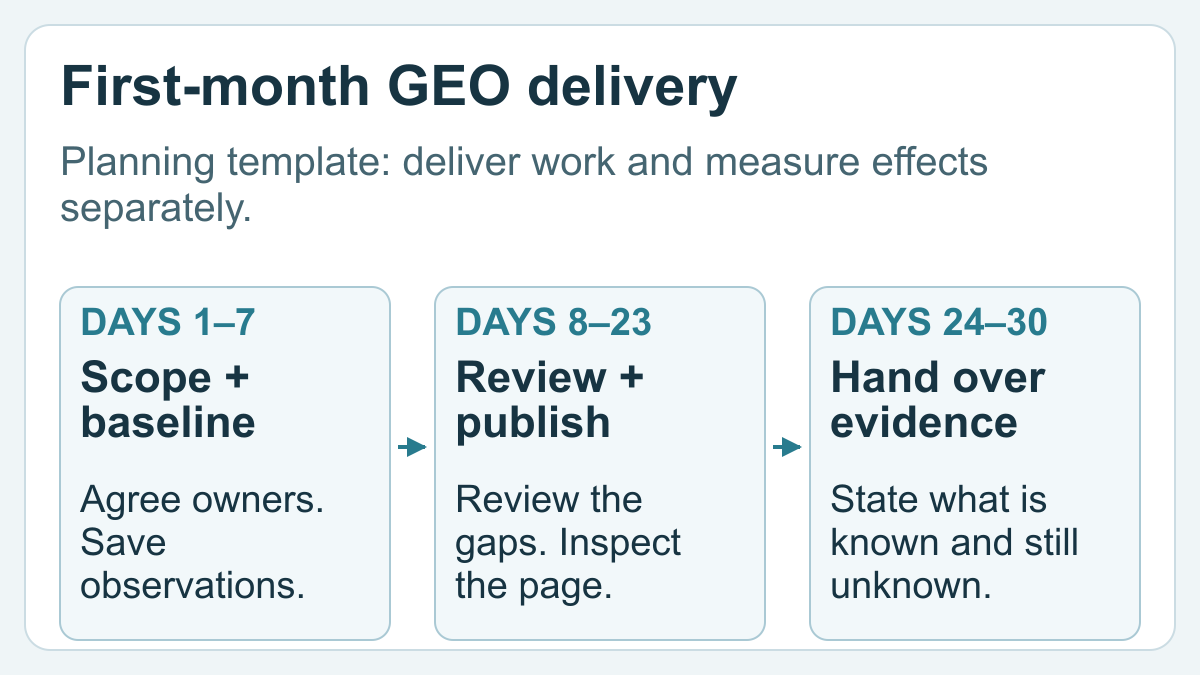
The schedule below is a planning template. Adjust it for access and approval delays. It is not a forecast of how quickly an answer engine will select your pages.
Days 1–3: Agree on the decision and the owner
Choose the commercial question before choosing a content quota. An illustrative service-business brief might focus on “Which provider handles this problem in my area?” and “What information do I need before requesting a quote?” Those are proposed questions, not measured search volumes.
Record the service, genuine coverage area, audience language, and action a useful page should support. Keep discovery questions separate from questions containing your brand. Give the business owner responsibility for factual approval, the editor responsibility for the explanation, and the technical owner responsibility for publication and access checks.
Your scope should also state what counts as evidence, which search surfaces will be observed, and who keeps access to the pages and reports. Our agency versus in-house comparison helps assign those responsibilities before work starts.
Acceptance: everyone can point to the same brief and identify the approver for every proposed change.
Days 4–7: Build a baseline someone else can reproduce
Save the exact wording of each selected question, the platform, date, location assumptions, language, and answer. Record a brand mention separately from a linked citation. Open the cited page and check whether it supports the statement beside it.
Include misses and contradictory answers in the evidence set. A screenshot showing one favorable answer is a sample, not a baseline that represents every customer. Use consistent observation conditions when repeating the questions, and document any conditions you could not control.
Review the pages intended to answer those questions. Google's AI-feature guidance says supporting pages must be indexed and eligible for a Search snippet; it does not require a special AI file or schema. This makes ordinary access and indexing problems legitimate first-month blockers.
Acceptance: another person can understand what was tested and distinguish an accessibility problem from an answer-selection problem.
Days 8–14: Turn gaps into reviewable changes
A gap should name a missing answer or a wrong fact. “Improve authority” is too vague. “Explain when an inspection is needed before a quote, with the service manager approving the limits” gives the writer a concrete job.
Rank the queue by customer consequence, factual confidence, and the work required. Correct an inaccurate service claim before creating another broad introduction to your industry. Improve an existing page when it already serves the question; create a new one when the reader needs a distinct explanation.
Each brief needs an intended audience, a direct answer, supporting evidence, important exclusions, and an approval owner. Google's people-first content guidance emphasizes useful, original value and clear sourcing. A longer word count does not replace those checks.
Use the AI search audit checklist to resolve foundational problems before assigning more pages.
Acceptance: each approved item explains what will change and how the reviewer will decide whether it is correct.
Days 15–23: Accept the published page, not the draft
Review the actual page on a phone and desktop. Confirm that the title, description, tables, answers, source links, and contact path survived publication. A draft containing an accurate FAQ is insufficient if the public page omits its answers.
For a changed Google-indexed page, an authorized Search Console user can request another crawl. Google warns that requests do not guarantee immediate indexing; repeated requests do not make the same URL crawl faster. Record the request and observed state separately.
For ChatGPT search, review the relevant access controls rather than assuming that any AI crawler setting is enough. OpenAI documents OAI-SearchBot and GPTBot as independent controls. Their different purposes are not interchangeable.
Acceptance: the approved version is visible at its intended URL, its important links work, and unresolved discovery or indexing issues have an owner.
Days 24–30: Hand over decisions and unfinished evidence
Use a compact acceptance table:
| Deliverable | Evidence to hand over | Acceptance question |
|---|---|---|
| Scope | Questions, audience, exclusions, owners | Did we agree on the same problem? |
| Baseline | Dated answers and source URLs | Can the sample be interpreted? |
| Fact review | Approved facts and correction queue | Which claims were checked? |
| Editorial work | Reviewed version and approver | Does it answer the intended question? |
| Publication | Public URL and page inspection | Did the approved content reach the page? |
| Follow-up | Comparable observations and open issues | What changed, and what is still unknown? |
Keep reporting layers separate. Google includes AI-feature traffic in Search Console's overall Web performance data, according to its official guidance; an aggregate click increase is not a count of AI citations. Recognized referral visits and qualified inquiries require their own evidence. Our GA4 referral and leads guide explains that distinction.
End the handover with one decision per unresolved item: correct it, observe it again, wait for a stated dependency, or remove it from scope. “Published; indexing not yet confirmed” is a useful status. “GEO completed” hides the next decision.
FAQ
Does a 30-day plan mean citations should improve within 30 days?
No. Thirty days is a delivery and review window in this template. A citation increase is a separate observation, dependent on the engine and the sampled questions. Accept completed work against its agreed criteria and evaluate results with comparable evidence over time.
Must we publish a fixed number of articles in the first month?
No. Set output commitments after reviewing the gaps and approval capacity. One corrected service page may answer a more important customer question than several general articles. Agree on the specific improvements and the evidence needed to accept them.
What if the business cannot provide source material?
Record which claims remain unverified and give them an owner. Publish only explanations supported by available evidence and approved operating facts. Do not fill a missing price, credential, policy, or service limitation with a plausible guess.
Can a passing content score replace business approval?
No. A score may help organize editorial review, but it does not establish that a service, price, qualification, or operating policy is true. The person responsible for the business claim should approve it before publication.
What should the month-end report recommend?
It should recommend the next specific action supported by the evidence: resolve an access problem, correct a source, expand a useful topic, or collect another comparable sample. Include the owner and the missing proof so the next cycle starts with a decision.